Three national dates fall close together each year, and they are not the same kind of day. One is a celebration, one is a remembrance, and one is the country's birthday. Children often come home having mixed them up.
Here they are in order, with what each one marks and what your child is likely to be doing.
At eleven in the morning, flags go up across the country. Schools, ministries, offices and government buildings raise them at the same time.
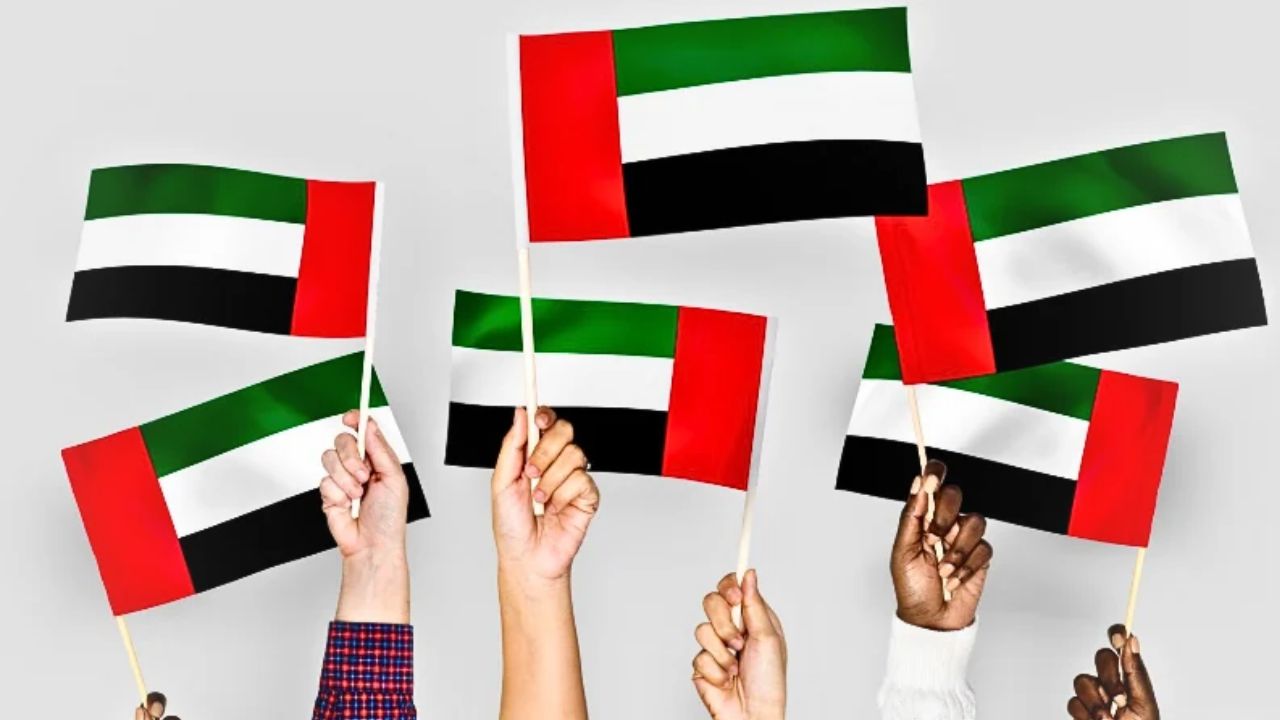
UAE Flag Day marks the anniversary of Sheikh Khalifa bin Zayed Al Nahyan taking office as President in 2004. It has been observed since 2013. It is not a public holiday, so school runs as normal.
For children, this is the simplest of the three dates and the most visual. Younger classes usually make flags, learn the four colours and what they stand for, and gather outside for the raising. Older students take the ceremony itself, read in assembly and often speak.
If your child comes home talking about red, green, white and black, this was the day.
Commemoration Day honours Emiratis who died serving the country. It is a day of remembrance rather than celebration.
Schools mark it quietly. There is usually a short assembly, a minute of silence at eleven thirty, and an age appropriate explanation of what the day is for.
If your child asks you about it, a simple answer is enough. Some people gave their lives for this country, and today it thanks them. Younger children do not need more than that.
This is the one date in the five weeks that carries no decorations and no activities, and that is deliberate.
This is National Day, now officially called Eid Al Etihad, the Festival of the Union. It marks 2 December 1971, the day the United Arab Emirates came into being. In 2026 the country marks 55 years.
This is the big one. Expect a heritage day, traditional dress, Emirati food, music, dance, poetry and a great deal of noise. Expect your child to need a kandura or an abaya, and expect the reminder to arrive later than you would like.
Expect, too, that they will come home knowing more about Sheikh Zayed bin Sultan Al Nahyan than you do.
| Stage | What children do |
|---|---|
| Pre-KG to KG2 | Colours and flags, songs, simple stories about the country, dressing up |
| Grades 1 to 5 | The seven emirates by name, who Sheikh Zayed was, what union means, art and craft, class presentations |
| Grades 6 to 8 | How the country formed and why, life before and after oil, geography of the region, research projects |
| Grades 9 to 12 | Governance, the economy, the country's international position, debates, speeches, organising the younger students' events |
The jump between the middle and senior bands is the interesting one. A nine year old learns the story. A sixteen year old starts asking how a federation of seven emirates actually works and why it held together when other unions did not.
This is not a week off from the curriculum. It connects to subjects your child studies all year.
Moral, Social and Cultural Studies covers the geography and history of the Emirates, how society and government work here, and the values the country sets out for itself. The national dates are the point in the year when that subject becomes visible.
The school also runs a National Identity Markers curriculum alongside the academic programme, which carries this work through the year rather than only in November and December.
For families following the Indian curriculum, this matters more than it might appear. Your child is growing up in a country that is not the one on their passport, and will one day be asked about it. Children who can talk about where they grew up, name its leaders and explain its history carry something useful. Children who spent twelve years here and cannot are oddly rootless about it.
Our blog on Arabic, Islamic Education and Moral Studies explains how these subjects are structured across the grades.
Learn the flag with them. Four colours, and your child will know what each one stands for by Grade 2. Let them teach you.
Say the seven emirates out loud together. Abu Dhabi, Dubai, Sharjah, Ajman, Umm Al Quwain, Ras Al Khaimah and Fujairah. Most adults who have lived here for years stumble on the order.
Go and look at something. Qasr Al Hosn, Qasr Al Watan, the Founder's Memorial and the Sheikh Zayed Grand Mosque all sit within reach, and all of them do a better job than any worksheet.
Watch the fireworks. It is not an educational activity and it does not need to be.
Sort the outfit early. Every year, a run on children's national dress begins around 28 November. Every year, families who left it late discover this.
What is UAE Flag Day?
A national occasion on 3 November, marked by raising the flag at eleven in the morning. It has been observed since 2013 and is not a public holiday.
Is Commemoration Day the same as National Day?
No. Commemoration Day on 30 November honours Emiratis who died in service of the country. National Day on 2 December marks the formation of the United Arab Emirates.
Why is National Day now called Eid Al Etihad?
The country adopted the name Eid Al Etihad, meaning Festival of the Union, which describes what the day marks.
What should my child wear?
Schools usually ask for national dress or the flag colours for the Eid Al Etihad celebration. The school will confirm nearer the time.
The flag goes up at eleven. Children line up outside, the older ones read, the younger ones hold flags they made themselves and mostly watch the older ones.
It takes about fifteen minutes and it is one of the better quarter hours of the school year. If you can get here for it, do.
Our school life page sets out the term calendar, our guide to the CBSE curriculum in Abu Dhabi shows where these subjects sit in the wider programme, and the office can tell you the arrangements for each of the three dates.
Written by Bright Riders School Abu Dhabi. Last updated 26-10-2026.